How To Install Paint Protection
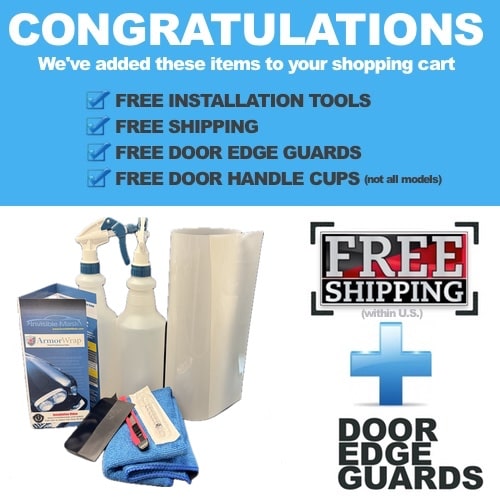
On precut orders that total over $75.00 we include a free professional toolkit and online How-To video that will go over the hood, fender, mirror and bumper installation. It also covers the preparation of the two solutions you will need to use for the installation and some tips to get the best looking results that you will be happy with.
If your order is under $75.00 you can add the installation kit or individual tools (click here) to your cart. We will send you a link to our How-To video with your order.
CLICK HERE FOR WINDOW TINT INSTRUCTIONS
CLICK HERE FOR WINDSHIELDX PPF INSTRUCTIONS
- Soft Installation Squeegee
- Spray bottles (quantity: 2)
- Baby shampoo
- 70% Isopropyl rubbing alcohol
- Non Scratch Detailing Cloth
Soap Solution (squirt bottle 1)
Scotchgard Pro Add 1–1.5cc of baby shampoo to the bottle. Fill with water.
ArmorWrap Premium / ArmorWrap Ultra Add 0.5cc–1cc of baby shampoo to the bottle. Fill with water.
Alcohol Solution (squirt bottle 2)
Scotchgard Pro Add 8 ounces of rubbing alcohol to the bottle. Fill with water.
ArmorWrap Premium / ArmorWrap Ultra Add 8 ounces of rubbing alcohol to the bottle. Fill with water.
- Setup and work in a dust-free environment with little or no wind, and out of direct sunlight.
- Be sure the painted surfaces to be covered are both clean, dry and free of wax residue.
- Pre-mix both the soap solution and the alcohol solution before you begin.
- The soap solution is your main installation solution and will be used for most of the install.
- The alcohol solution is only used when you need quicker tack, when edges are lifting, or when an edge is being stretched into place.
- Don’t rush the installation.
- Curved surfaces may require stretching of the material to lay flat.
1. The optimum environment is a temperature range between 50 and 90 degrees (Fahrenheit) and never apply in inclement or windy weather. (Applying indoors may be advisable here.) If your temperature is below 50 degrees Fahrenheit we suggest using warm water in your squirt bottles and running the car beforehand to get the hood area warm.
2. Above we have specified the mixtures for the soap solution and alcohol solution. The soap solution will be used for the majority of your installation. The alcohol solution should only be used when you need a section to stick right away, when edges are lifting, or on certain stretched edge areas that need to lock down.
3. By spraying the soap solution onto the intended surface to be covered, and then wiping it off with your gentle cloth, you should have no trouble eliminating any oil, grease, dirt, or any other contaminant.
4. Before removing the liner, make certain you confirm all part placements and sizes.
5. Once you’re ready to begin, remove all dirt from your hands. If even the tiniest bit of dirt is ignored, this will relocate to the adhesive and cause a very unattractive appearance. It’s also advisable to keep your fingers wet to avoid them from sticking to the adhesive. Never handle the adhesive side unnecessarily. Occasionally, you will need to handle it but it must be done lightly and quickly. Fingerprints will transfer through the material if handled too often or too long.
6. Be certain to remove any wax on the section that your kit will be installed onto since this must not be put onto a vehicle that has been newly waxed. Note: Dishwashing detergents are one method of stripping wax from a painted surface. You can also use "3M Adhesive Remover" or something comparable to remove any wax.
Hood Kit
1. First, use the slip solution to thoroughly wet the hood. Keeping your fingers wet and the material rolled up, carefully separate a small portion of the film from the liner on one end. As you begin pulling the liner away across the hood, continuously spray the adhesive side of the film with slip solution. This prevents the film from sticking prematurely.
While holding the remaining rolled portion in one hand, gently lay the exposed film onto the hood as the liner is removed. Be careful not to overstretch or tear the material, especially around any relief cuts (small cuts designed to help the film conform to curves). Use your fingers as needed to guide the film and release the liner cleanly around those areas.
2. Once the film is on the hood, you’ll need to position it. Lightly lift sections of the film and spray additional slip solution underneath so it can move freely. Also spray the top surface of the film before using a squeegee—this prevents dragging or shifting.
3. With the film freely movable, align and center the kit, leaving about a 1/8” gap from the front edge of the hood.
Due to the contours of the hood, especially on curved surfaces, it is normal for the material to require slight stretching to reach the edges. This is expected and part of a proper installation.
4. Once aligned, you’ll need to lock the film in place. In many cases, you can squeegee a vertical strip (about 3–4 inches wide) down the center of the hood to anchor it.
In other cases, a “coast-to-coast” method may be used—starting on one side, stretching the film across to the opposite side, locking that edge down, and then squeegeeing the remaining area in between.
5. Now begin working the film outward from your anchored section. Use firm, overlapping squeegee strokes to push the slip solution out toward the edges. Continue working section by section until the majority of the film is laid down smoothly.
6. The alcohol solution should only be used as needed—primarily for edges or small areas that need to tack down immediately, for lifting edges, or for stretched edge areas that need help locking into place. Lightly spray only those areas and squeegee them down.
7. Continue squeegeeing from the anchored area outward, working in overlapping passes toward all edges. Maintain firm, even pressure to remove all water and air. Keep the surface lightly wet with slip solution so the squeegee glides smoothly.
8. If edges lift, wrap your squeegee in a paper towel and go over those areas to absorb excess moisture. For stubborn edges, you can use a small amount of alcohol solution and even apply gentle heat with a blow dryer to help the film conform and stay down.
9. Once one side is complete, repeat the same process on the remaining sections until the entire hood is finished.
Mirrors
1. First, use your squeegee to tack down one end of the material.
2. By stretching the material from one side to the other, and then from top to bottom, you will be able to pull out any extra material. This will help to avoid bubbles.
3. After you have the material in place, begin working in the center and squeegee the remaining material to the outside edges.
4. To avoid any edges from lifting back up, use your paper towel wrapped squeegee to smooth out the edges. If needed, use a small amount of alcohol solution only on stubborn edges or areas that need to tack down faster.
Fenders
1. Begin by aligning the fender edge with the upper edge piece. Double check to be sure you leave 1/8” gap both along the upper edge and the front edge. Use the soap solution as your main installation solution to position the piece.
2. Now, using your squeegee very gently, begin making a narrow pass on the upper edge of your fender piece. Remember not to press so hard that you move the positioning of your piece. You can begin pressing firmer as the material begins bonding with the paint.
3. If a section needs to tack more quickly, if an edge is lifting, or if you are stretching an edge into place, you can lightly use the alcohol solution on just those areas. While gently pulling the material with one hand, use the squeegee in the other hand to firmly pass through the section and lock it down.
4. Complete your piece by repeating the passes with your squeegee to remove any bubbles or air pockets. When working on vehicles such as Chevrolet or GMC pickups that have fenders with extreme contours, you may need to wrap your squeegee with a paper towel to ease out any persistent areas.
Bumper, Spoilers, Airdams
Bumper kits are typically the most challenging part of the vehicle to install due to their complex shapes and curves. As a general rule, the flatter the surface, the easier the installation. The more curves and contours a bumper has, the more stretching and technique will be required to achieve a proper fit. For larger bumper pieces, installers also have the option to splice the kit into smaller sections to make the installation easier. However, keep in mind that this will result in a visible seam when viewed from a few feet away. Because of these variations in bumper design, some additional techniques may be required for certain vehicles. The following are examples of more complex applications:
- Chevrolet Corvette
- GMC Yukon Denali
- Porsche Boxster
- Porsche 928
1. Due to the unique curvatures of bumpers, stretching the material is required to achieve a smooth result. Thoroughly wet the surface with the soap and water solution. As you remove the liner, continuously spray the adhesive side with soap/water to prevent premature sticking. Lay the film onto the bumper.
2. Using the soap solution, keep both the surface and the top of the film well lubricated so the material can move freely. Position the kit by aligning key reference points such as a tow hook cutout, parking sensor, or a defined edge in the bumper.
3. Installation will typically begin near the center of the bumper—often around a tow hook opening or parking sensor—not necessarily the exact middle. From this starting point, begin working the material toward one side while keeping alignment with nearby features such as additional sensors, body lines, or edges.
4. As you work toward one side, use firm, controlled squeegee strokes to push out the slip solution while lightly stretching the material as needed to follow the contours of the bumper. Keep the remaining sections wet so they stay adjustable.
5. The outer edge sections are typically completed last. These areas often require the most stretching due to the curvature of the bumper.
6. If certain areas need to lock down more quickly—such as edges, tight curves, or stretched sections—you can use a small amount of alcohol solution only in those specific areas. Do not use it broadly, as the soap solution should remain the primary installation fluid.
7. Continue working section by section, maintaining proper alignment while removing all solution and air with overlapping squeegee passes.
8. After the film is fully laid down, inspect for any fingers or lifting edges. These can be worked down using firm squeegee pressure, slight stretching, and, if needed, a small amount of alcohol solution or gentle heat to help the material conform.
9. Repeat the same process in the opposite direction from your starting point until the entire bumper is completed.