WindshieldX Installation -
Windshield PPF Installation Instructions
Follow the steps below carefully. Take your time—cleanliness and keeping surfaces wet are the keys to a smooth install.
Tools Required
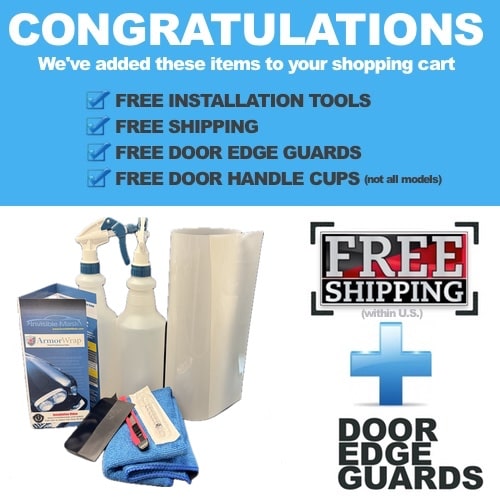
- Included with your film: Squeegee, scrub pad, razor knife
- You will need: Johnson’s® Baby Shampoo, squirt/spray bottle, clean microfiber towels
Add a 3-4 drops of Johnson’s® Baby Shampoo to water in your spray bottle and mix gently.
Windshield Preparation
- Wash vehicle beforehand
- Thoroughly clean windshield
- Spray glass with soap & water solution
- Scrub with included scrub pad
- Squeegee glass dry
- Repeat once more (optional)
- Spray glass one more time leaving soap/water in place.
IMPORTANT NOTE: The squeegee process is vital for a quality outcome. A common mistake is not using firm, overlapping strokes with the squeegee. This can result in bubbles under the film. Very small bubbles will usually dry out and disappear over time, but larger ones can remain as air pockets. (small as in the tip of a pencil)
Be sure to apply firm pressure when squeegeeing the film. Wipe water off the film and then sit inside the vehicle and inspect the windshield for larger bubbles. If you see any, lift the film in that section and re-squeegee it.
The film will not look perfectly clear until it fully dries, which can take 3–8 hours. Don’t panic if the windshield looks hazy or blurry immediately after installation—this is normal and will clear up completely as it dries.!
Watch the Installation Video
Recommended before you begin.
If the video does not display above, use the “Watch on YouTube” button.
Installation (Start to Finish)
- Set up a wet “prep table” on the hood.
Spray the hood generously with the soap & water solution. This gives you a clean, wet surface to work on. - Lay the film on the wet hood (adhesive side facing up).
Place the windshield film as a loose rectangle on the hood. This is only a staging area. - Peel the liner while spraying the adhesive side.
Begin peeling away the protective liner. As the liner separates, continuously spray the adhesive side with the soap & water solution. Keep it wet to prevent premature sticking. - Thoroughly wet the windshield.
Before moving the film, spray the windshield generously with the soap & water solution. The glass should be very wet. - Pick up the film and lay it onto the windshield.
Carefully lift the film from the hood and place it onto the wet windshield. The film will slide on the wet surface. - Hand-position and align the film.
Use your hands to gently flatten the film and align it as evenly as possible on the windshield. Don’t worry about perfection yet—just get it centered and sitting flat. - Start squeegeeing using a “+” (cross) pattern.
Begin in the center and squeegee a vertical stroke, then a horizontal stroke, forming a “+”. This locks the film in place. - Work in quarters (1/4 sections) from the center outward.
Continue squeegeeing one section at a time: top-left, top-right, bottom-left, bottom-right. Use firm, overlapping strokes to push solution out toward the edges. Wipe off water from film, sit inside vehicle and inspect for missed spots or large bubbles. If found then lift up the film in that section and re-wet, then repeat process. - Finish the edges.
Once the main sections are set, squeegee along all edges to ensure they are fully seated. - Trim excess film (razor knife).
After the film is fully squeegeed and stable, carefully trim away any excess film with the included razor knife. Use light pressure and controlled cuts. - Let the film cure.
Allow the film to cure for about 24 hours. Avoid washing the vehicle or using windshield wipers during the cure period.
In rare cases, on very curved windshields, a heat gun can be used to remove fingers from the film when the squeegee alone cannot fully lay it down.
- Working in a dirty or windy or hot environment
- Letting the adhesive side dry while handling
- Squeegeeing randomly—lock the film first with the “+” pattern, then work in quarters
- Trimming before the film is fully set/squeegeed
- Not using firm overlapping strokes with the squeegee which will leave bubbles under the film